When "Good Enough" Just Isn't Enough
Have you ever installed a custom caliper bracket, only to feel it shake violently when you hit the brakes at high speed?
Or maybe you are an engineer in Cavite, watching your automation line produce defects because a jig is slightly off-center?
We know that feeling. It’s frustrating, and honestly, it’s dangerous.
In the Philippines, whether you are modifying a superbike for the track or running a 24/7 semiconductor line, one truth remains: Precision is everything.
A difference of 0.1mm might not look like much to the naked eye. But for a high-performance engine or a robotic arm, that tiny gap is the difference between a smooth run and a total failure.
Here is the good news: The problem often isn't your design. It’s the manufacturing method.
In this guide, we are going to break down the two pillars of custom CNC parts: Milling and Turning.
We will help you choose the right process for your specific needs, so your next part doesn't just look good—it performs perfectly.
1. Milling vs. Turning: Is Your Part a Brick or a Stick?
We see this confusion all the time. You have a design, but you aren't sure which machine should make it.
This isn't just a technical detail. Choosing the wrong process can double your cost.
Let's throw away the textbook definitions and look at it this way:
The Sculptor (CNC Milling)
Think of CNC Milling like a sculptor working on a block of stone. The material block stays stationary (mostly), and a high-speed rotating tool moves around to cut away the excess.
Best for: Square shapes, flat surfaces, and complex brackets (like a Triple Clamp).
The Potter (CNC Turning)
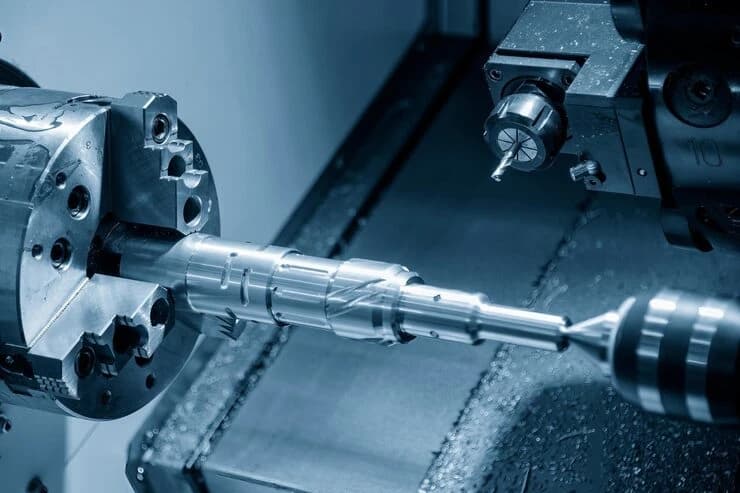
Think of CNC Turning like a potter working on a wheel. The material spins at high speed, and a stationary tool shaves off layers, peeling it like an apple.
Best for: Cylindrical shapes, pins, and shafts (like a Wheel Axle).
The "Which Machine?" Checklist:
Still not sure? Use this 3-second rule:
[ ] Is it round? -> Go for Turning. It guarantees perfect concentricity.
[ ] Is it square or irregular? -> Go for Milling. It handles complex geometries.
[ ] Is it round but has side holes? -> You need our Turn-Mill capability (best of both worlds).
Further Reading: Need a visual guide? Check out this article on Milling vs. Turning: What's the Difference? to see these machines in action.
2. Motorcycle & Automotive: Beyond "Good Looks"
In the world of custom modification, we often see a dangerous trend:
People choose parts based on the anodized color, not the engineering behind it.
Why Do Some Custom Parts Fail?
We have seen it happen in Motorcycle parts machining projects. A rider buys a cheap, shiny "CNC" rearset online. It looks great in the photo. But halfway through a track day, it snaps under pressure.
Why? Because it was machined from cheap, recycled aluminum to save cost, and the sharp corners created stress points.
When you are riding at 100 kph, you aren't just trusting the part; you are trusting your life with it.
The "High-Performance" Standard:
For critical components like Triple Clamps, Caliper Brackets, or Rearsets, looks should be the second priority. Safety is first.
Material Matters: We recommend AL7075-T6 (Aerospace Grade) for high-stress parts. It’s as strong as some steels but light as a feather.
Stress Relief: Our engineers add fillets (rounded edges) to critical areas. This simple design tweak prevents cracks from forming under vibration.
Before vs. After:
❌ Cheap Machining: Sharp edges, visible tool marks, unknown material strength. -> Risk of fatigue failure.
✅ Precision CNC: Smooth surface finishes, radiused corners, certified AL7075 material. -> Race-ready durability.
Internal Link: Want to see what real quality looks like? Check out our Product
3. Industrial Automation: The Unsung Heroes of the Assembly Line
If you are running a production line in Laguna or Batangas, you know that the most expensive thing in your factory isn't the raw material—it's downtime.
Jigs and Fixtures: Stability is Everything
We often call Jigs and Fixtures the "unsung heroes" of manufacturing. They don't look fancy, but they hold the entire operation together.
Imagine a robotic arm trying to pick up a chip. If your positioning jig is off by just 0.5mm because of poor machining, the robot misses. The alarm sounds. The line stops.
Why "Cheap" Jigs are a Financial Trap:
A poorly machined fixture might save you 1,000 PHP upfront. But if it causes a 1% defect rate on your assembly line, it could cost you 100,000 PHP in rejected products by the end of the month.
Our Automation Promise:
We specialize in high-precision Automation components like:
Sensor Brackets: That stay rigid even under heavy machine vibration.
Testing Jigs (Pogo Pin): Machined with Peek or Delrin for perfect insulation and alignment.
Conveyor Guides: Wear-resistant parts to keep your flow moving.
We guarantee key dimensions within ±0.01mm. Because on your line, "almost" is not good enough.
Further Reading: Why is precision tooling so critical? Read this guide on The Importance of Jigs and Fixtures to see how they directly impact your production efficiency.
4. Surface Finishing: Beating the Philippines' Humidity
Here is a common myth: "Aluminum doesn't rust, so I don't need to paint it."
Here is the reality: In the tropical, humid climate of the Philippines, raw aluminum oxidizes quickly. Within weeks, your shiny new part will turn dull, develop white powdery spots (corrosion), and eventually pit.
Don't Let Your Parts Go "Naked"
For both automotive custom parts and industrial jigs, surface finishing isn't just about making it look cool—it’s about protection.
We offer a one-stop solution. You don't need to coordinate with a separate anodizing shop; we handle the machining and the finishing, delivering a ready-to-use part.
Which Finish Do You Need?
Clear Anodize (Type II): The standard for automation parts. It keeps the metallic look but adds a corrosion-resistant shield.
Hard Anodize (Type III): The "heavy duty" option. Perfect for engine internals, cylinders, or any part that faces friction. It’s harder than tool steel.
Powder Coating: Best for chassis parts or brackets exposed to the road. It offers a thick, durable layer that resists rock chips and scratches.
Color Anodize: Want your bike parts to match your team colors? We can do Gold, Red, Blue, or Black.
Pro Tip: For precision holes (like bearing pockets), tell us before we machine. We need to calculate the coating thickness (usually 0.01mm - 0.05mm) to ensure the final fit is perfect.
Further Reading: Not sure which type of anodizing to choose? Read this guide on All About Aluminum Anodizing to understand the difference between Type I, II, and III.
Let's Build Something That Lasts
Whether you are chasing a 0.1-second improvement on the race track or a 10% efficiency boost on the assembly line, you need parts that perform.
Don't settle for "good enough."
In the humid, demanding environment of the Philippines, cheap machining and poor finishing are just expensive failures waiting to happen.
You have the vision. We have the machines.
Ready to turn your drawing into reality?
It doesn't matter if you have a complex 3D CAD file or just a sketch on a napkin. Our engineers speak your language.
Let’s discuss the best process—Milling or Turning—for your project.
Contact Yu Cheng PH today, and let's get your custom parts made right the first time.